In the modern, fast-paced, and linked world, where borders are becoming more porous and information flows ceaselessly, it is typical to feel overwhelmed by the sheer volume of the various demands, options, and duties that are placed on one. The constant flood of data, when combined with the pressure to juggle many tasks and responsibilities, can give one the impression that they are lost in a terrain that is ever-evolving. Nevertheless, included within this boundless world is the possibility of elevating oneself from a condition of powerlessness to one of overpowering chaos and seizing that chance.
The trick is not in constructing impenetrable barriers to shelter oneself from the outside world; rather, it is to effectively traverse that environment. This path calls for an approach that takes a holistic view and incorporates practices such as mindfulness, purposeful goal-setting, the establishment of healthy limits, effective time management, and an unrelenting dedication to personal development and adaptation.
During this investigation, we will look into specific actions that you may take to move from a state of feeling overwhelmed to one of embracing your own sense of empowerment. You may tap into the limitless potential of today’s world without compromising your health if you develop your self-awareness, are open to change, and have mastered strategies to manage your time and energy.
A growth mentality and an adaptability quotient (AQ)!
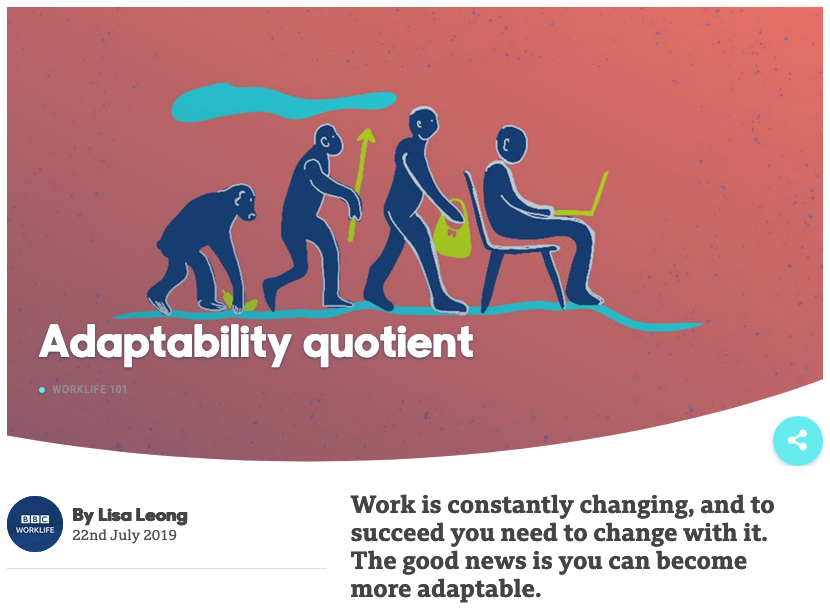
A growth mentality and what I call the adaptability quotient (AQ), both of which enables us to engage the world in a manner similar to that of researchers, come into play here. A growth mindset and high AQ are the keys to success.
and learning rather than as obstacles that stand in the way of progress.
A high AQ, on the other hand, refers to an individual’s capacity to unlearn, relearn, and alter course in response to the introduction of new knowledge. It requires tenacity, resilience, and mental agility to make sense of a world full of contradictions and see the beauty that may be found in those very contradictions. An efficient remedy for the paralysis that might result from rapid change is having a growth mindset and a high adaptive quotient.
The journey from overwhelmed to empowered is a process!

A fundamental process of self-discovery and development is at the heart of the transformation from powerless to self-sufficient. It requires acknowledging that feeling overwhelmed is a normal reaction to the numerous challenges posed by a world without boundaries.
However, inside this chaos is the possibility of a shift taking place. We are able to retake control over our lives when we cultivate conscious self-awareness, set purposeful goals, and create healthy boundaries. Time management emerges as a useful instrument for maximizing production while warding off burnout. Accepting change and learning. Our effect is magnified when we work together, which serves as a reminder of our interdependence.
The Sprint Approach demonstrates the effectiveness of innovation that is founded on empathy. We acquire the ability to flourish while not knowing what the future holds at each stage of this journey. It is not about eliminating obstacles but rather about welcoming them as opportunities to grow and become more self-reliant. As we traverse this process, we rewrite our narratives, transitioning from being overwhelmed viewers to being powerful participants and molding our lives with intention and resiliency in the process.
Challenge for Those With a Growth Mindset!
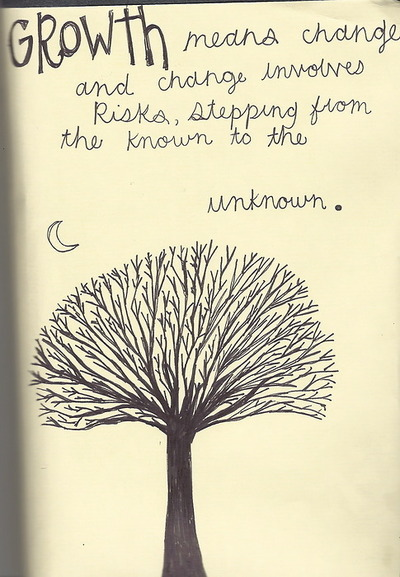
This premised belief that talent and intelligence are just the starting points of success and that success happens through hard work, experimentation, the willingness to learn from mistakes, and perseverance. This is in contrast to the fixed mindset, which relies solely on talent as the measure of success, so that you protect your talent through perfectionism and avoid taking risks or making mistakes because those missteps will reveal that you are not, in fact, talented.
Explore once a week or once a month, in which members of the team are challenged to attempt new things and stretch themselves outside of their comfort zones. This might mean anything from acquiring new talent to taking the lead on a project that falls outside of the scope of their typical responsibilities. I would like to suggest a game that I have dubbed the Yeti Challenge. First, each participant identifies an area in which they are deficient.
For example, a person may say, “I’m not good at math” or “I don’t understand math.” Instruct them to add the word “yet” to the statement now. Now, at long last, it is time to take action. Include “I” in the sentence, as in “I’m not very good at math, YET I will find a tutor or register for an online course by the end of the week.”
Workshops on Adapting to Change is a Tip!
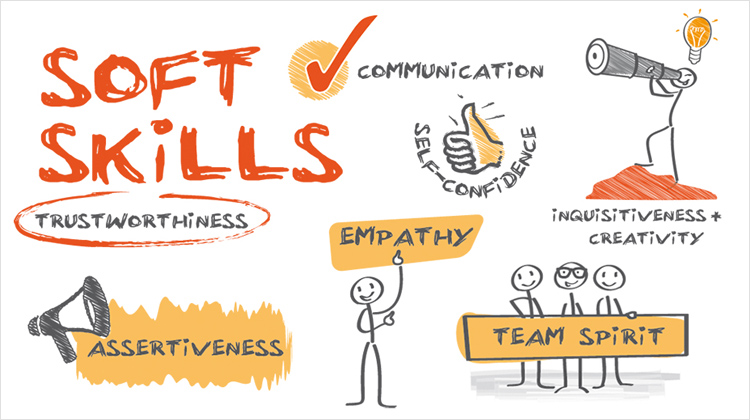
Change is the dynamic thread that weaves moments of development, resilience, and growth. Our capability to adjust to new circumstances, like the way a tree sways in the wind, is directly proportional to our robustness and our ability to grow. Imagine that the process of transition is a workshop, a place where we may hone our skills of adaptability, discover how to move gracefully in the face of ambiguity, and accept the unknowable as a chance for growth and refreshment.
The purpose of these seminars on adjusting to change is not only to ensure one’s continued existence; rather, they emphasize personal agency. They present us with an opportunity to tap into our own latent reserves of bravery, creativity, and inventiveness. Every change in the environment is an invitation to build a better version of ourselves, paring away the unnecessary parts in order to expose the masterpiece that already resides within.
Organize participatory workshops that operate as simulations of improbable scenarios or quick transitions. Your team should be broken up into smaller groups, and each of those groups should be given a scenario in which they must adjust to a rapid change in some aspect of the project parameters, market circumstances, or team dynamics. Ask each team to determine how the qualities connected to AQ.
Adopting the Frame of Mind of a Researcher!
When we have a high AQ and a growth mindset, we are able to think like researchers because we are able to learn and adapt. Because of this, we are able to view any challenge as an interesting experiment from which we may gain knowledge. This necessitates letting go of the notion that we need to always know the answer to a problem before we can go forward, and replacing it with an attitude that is characterized by humility, empathy, and a willingness to grow.
In order to do this, we must first let go of the concept that we need to always know the solution to a problem before we can move forward.
Make Smart Errors Is the Advice Here!

It is more than simply advice; “Make smart errors” is a guiding concept for navigating the intricacies of life and progress. “Make smart errors.” Mistakes are unavoidable, but how we choose to respond to them will determine the course of our lives. Rather, try to avoid making mistakes.
Errors that are the result of curiosity, exploration, and taking measured risks are examples of smart errors. It is the failures that force one to push one’s limitations, test one’s boundaries, and broaden one’s mindset. You will participate in a constant process of learning and improvement if you make mistakes that are purposeful. Each slip-up presents an opportunity to gain fresh understanding, revise one’s approach, and find unexplored routes.
Keep in mind that many of the most significant breakthroughs in human history are the result of unsuccessful attempts or unintended consequences. These mistakes are the essential elements for development. Accept them, analyze them, and allow them to shed light on the path you’re traveling. You can rewrite the story that surrounds failure and turn it into a guiding light for empowerment by mastering the skill of making intelligent mistakes. Your ability to learn, to bounce back from setbacks, and to persevere in the quest of excellence is a testament to your willingness to make clever mistakes.
What would happen if some of the most reliable assumptions you make about the way you do business turned out to be incorrect? What if it turned out that they were really causing you to lose market share or prevented you from doing something that had the potential to dramatically boost your bottom line?
Collaboratively creating and planning for impact!

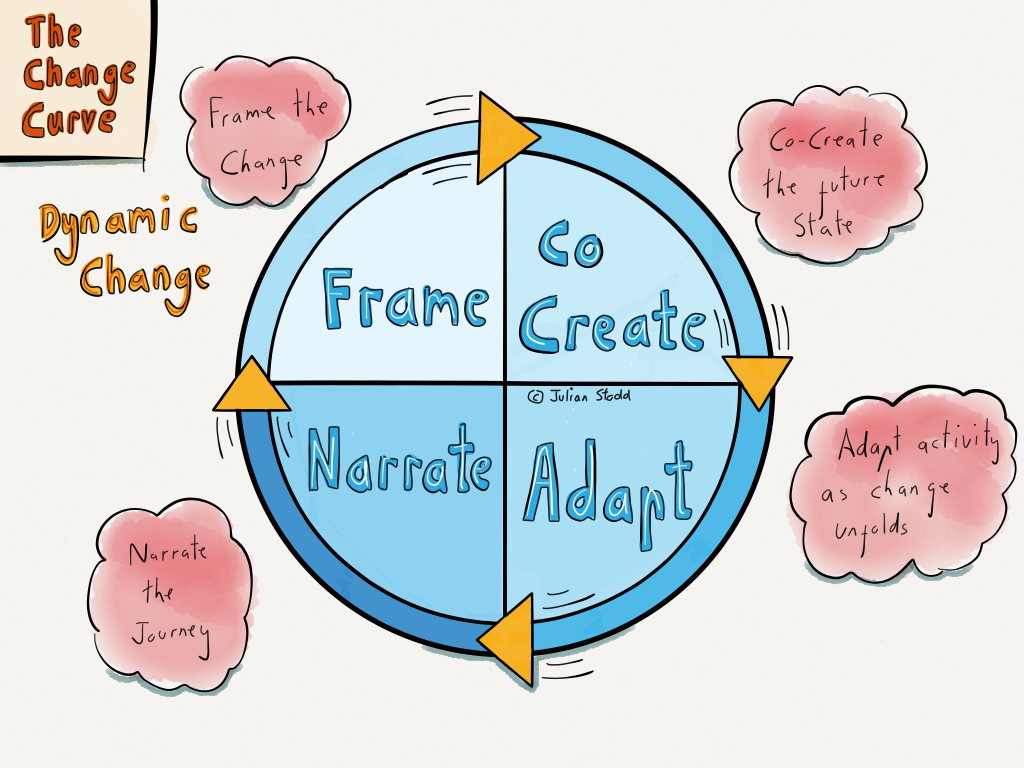
The process of coming up with ideas and plans for effective collaboration with other people is a fluid one that makes use of the combined intelligence of a variety of perspectives. When we combine our thoughts, areas of expertise, and points of view, we create a synergy that pushes us beyond the confines of our own unique capabilities. We are able to design tactics that ripple with purpose by engaging in open conversation and sharing our views. This allows us to broaden our reach and bring about significant change.
It serves as a reminder that our collective efforts are not only powerful but also vital in the process of sculpting a better future, not only for ourselves but also for the world in which we have some level of impact. Adopting a development mindset and having high emotional intelligence (AQ) also makes it easier to form collaborative partnerships. As conventional barriers continue to collapse, businesses and their people will have the opportunity to co-create.
More significantly, this frame of mind compels us to build strategies with a human-centred approach, giving priority to the results that are experienced by humans. This might imply anything from cultivating creativity to supporting inclusion to achieving a better balance between work and personal life.
The Sprint Approach to Human-Centered Design!
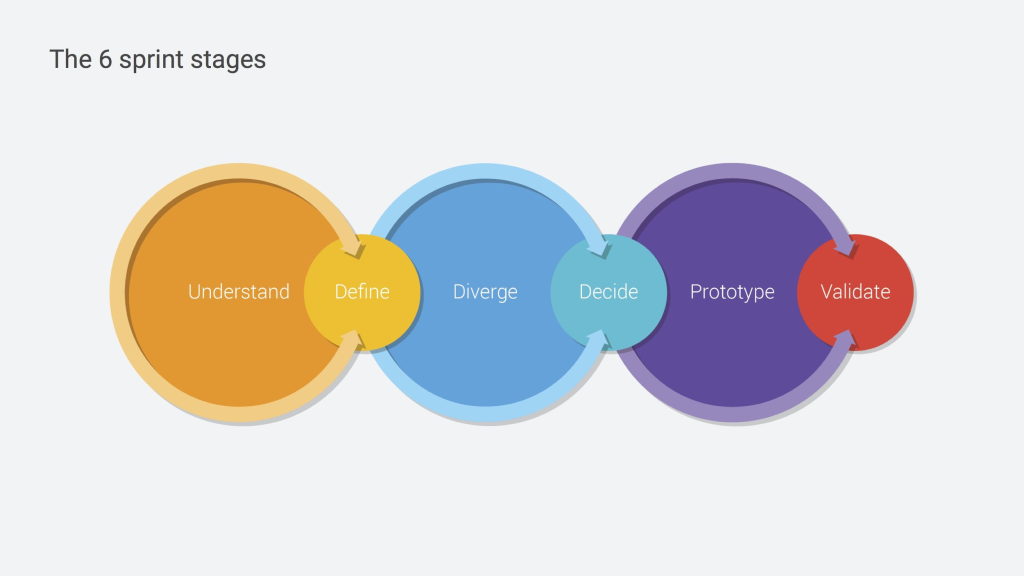
The Sprint Approach to Human-Centered Design exemplifies a path that is both swift and laser-focused on the destination of innovation. It is a methodical procedure that compresses the job that would normally take months into a few short weeks. This strategy cultivates empathy and reveals insights by assembling a team with a wide range of backgrounds, establishing a distinct objective, and immersing oneself in the point of view of the user. It does this by going through a number of systematic phases, including ideation, prototyping, and testing, which helps it zero in on ideas that are relevant to the demands of the actual world.
The sprint makes efficient experimentation, taking risks, and iteration possible, which ultimately results in refined solutions in the shortest amount of time possible. This dynamic strategy gives teams the ability to pivot rapidly, reducing the amount of guessing and increasing the amount of impact. The Sprint Approach encourages human-centred solutions that bring creativity and empathy into alignment in a world that is in a state of perpetual flux.
It is recommended that you carry out a design sprint, which is defined as “a time-constrained, five-phase process that uses design thinking with the aim of reducing the risk when bringing a new product, service, or feature to market.” Include phases in which you empathize with people, define user needs, ideate solutions, prototype, and test your product. The human-centred emphasis and the interdisciplinary team that will be participating in the sprint will naturally lead to co-creation.
Conclusion!
Our path from being overwhelmed to empowered is a monument to human adaptation and perseverance in the face of a limitless universe that is alive with knowledge and change. We can create a path that leads to empowerment if we practice mindfulness, if we aim for meaningful objectives, if we draw clear boundaries, if we are efficient with our time management, and if we promote a dedication to personal development. Keep in mind that change is not a problem that should be dreaded but rather an opportunity that should be grabbed. We exemplify the essence of growth and progress as we negotiate the workshops of adaptation that life presents us with and as we learn to make intelligent mistakes.
Our capacities are increased when we work together to produce and plan for an effect, which also serves to remind us that there is power in solidarity.
The Sprint Approach to Human-Centred Design embodies our capacity to innovate swiftly while also ensuring that our solutions are in line with actual requirements. Through this dynamic process, empathy and creativity collide to form a society that is characterized by the peaceful coexistence of empowerment and empathy. Our ability to navigate, invent, and rise to new heights will drive us toward a future that is rich with possibilities in a world without boundaries.
The rate of change in the world is dizzying, but rather than feeling powerless in the face of it, we have the option to choose to feel empowered. We are able to not only traverse the boundaryless world but also flourish in it by learning, adapting, and reinventing our path ahead if we have a growth mindset and have a high ability quotient (AQ). Instead of trying to fight change, the most effective strategy for achieving success in today’s fast-paced world is to welcome new experiences with an open mind and a strong will.