With all of its ongoing demands and conflicting priorities, modern life is a constant struggle between the pursuit of greater productivity and a harmonious work-life balance. The idea of “themed workdays” is a dynamic strategy that promises to alter the way that we approach our workweeks. It is a notion that has been around for a while. Consider that each day is a blank canvas on which you will paint a certain subject, a magnifying glass through which you will direct your efforts and energies. This innovative approach not only adds discipline to your daily work routine, but it also gives each day a fresh sense of purpose and the ability to advance toward a goal.
Theme Every Work Day for a More Productive Week!
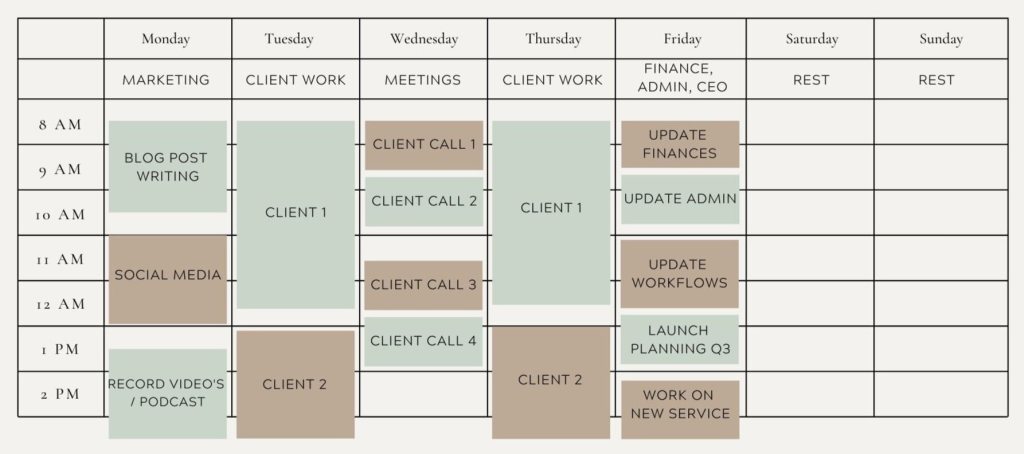
Create a productive workweek for yourself by structuring your work:
Monday is devoted to tactics and preparation.
“Setting the Tone”: At the beginning of the week, you should examine your objectives and top priorities.
“Mapping the Week”: Make a comprehensive plan for the activities and responsibilities that are scheduled for the forthcoming week.
“Goal Alignment” refers to the process of ensuring that your day-to-day activities are in line with your long-term goals.
“Task Breakdown” refers to the process of dividing large, complicated undertakings into a series of smaller, more manageable jobs.
Work and concentration on Tuesday
“Focused Morning” refers to the practice of devoting the morning hours to the uninterrupted and in-depth completion of a single activity.
“Information Diet”: Reduce the number of times you become distracted by just reading emails and material that is absolutely necessary.
“Digital Detox” refers to the practice of scheduling time away from digital gadgets in order to improve attention.
Wednesday is about working together and communicating with others.
“Team Sync” refers to the practice of scheduling team meetings and talks in order to synchronize efforts and objectives.
“Collaborative Projects” are any endeavours that call for the participation of many coworkers or members of a team.
“Effective Communication” requires a focus on communication that is both clear and consistent in all encounters.
“Feedback Loop”: Seek and offer feedback in order to improve the outcomes of cooperation and work.
Thursday is devoted to enhancing one’s abilities.
“Learning Time” refers to the time you set aside specifically to learn new skills that are pertinent to your profession or sector.
“Skill Application” is applying recently acquired knowledge to current initiatives or responsibilities.
“Knowledge sharing” refers to the act of sharing ideas or instructing coworkers on what you’ve learned.
“Continual Improvement” asks you to evaluate your current state and pinpoint areas in which you may benefit from more training.
Wrapping Things Up and Looking Back on Things on Friday
“Task Completion”: Put your attention on finishing up outstanding assignments and closing up any loose ends.
“Weekly Review”: Consider the things you’ve achieved, the challenges you faced, and the knowledge you gained.
“Preparation for Next Week” includes organizing your working area as well as your list of things to complete for the next week.
“Celebrate Wins” means to acknowledge your accomplishments and to give yourself a reward for having a successful week.
Keep in mind that adaptability is essential. Modify these motifs and captions so that they correspond most closely to the way you operate and the duties you have. The objective is to set up a system that will allow you to increase your productivity while still maintaining a good work-life balance.
Optimize time management to enhance productivity!

Improving one’s ability to manage their time well is one of the most important steps toward increasing productivity. To get started, begin by defining your goals, and then organize your tasks in order of importance using the due dates. It is much easier to handle large tasks when they are broken down into smaller, more manageable pieces, and particular time blocks should be set up for concentrated effort. Concentration may be maintained and mental exhaustion avoided by employing strategies such as the Pomodoro method. Review your calendar on a regular basis and make any necessary adjustments to keep it aligned with your goals.
Reduce the number of tasks you have to juggle, delegate where you can, and take advantage of the various technological solutions available. Keep in mind that you need to take breaks in order to recharge. You will be able to do more in less time, as well as increase efficiency and decrease stress, if you manage your time well. When you’re working on a significant project, you should make sure that each day has a distinct goal in mind.
Creating a plan for each day is an essential step in being more productive.
Timeboxing is one method for creating a full agenda, but there are other aspects of time management that are just as important. For the sake of maximizing your productivity, you should think about splitting not just your day but also your week as a whole. The key to success here is to give each day of work a different subject. Try collecting all of the related tasks together and marking them on a certain day rather than hopping from one task to the next on any given day.
This will save you time. By scheduling chores that are similar on the same day, you will be able to remain in the “zone” for a longer period of time and concentrate solely on what must be accomplished inside it. If all of the tasks you have to accomplish share something in common, it will be easier for you to maintain your concentration on the overarching goal of the job you have to complete for the day as you move from one task to the next.
The importance of themed days!

Themed days provide a methodical framework for enhancing both the productivity and the efficiency of labour. You may make a definite plan for achieving your goals and doing your chores if you centre each day on a single purpose. Your mind will be more prepared to tackle tasks that are linked to the topic at hand if you use this method.
In addition to this, it helps maximize the use of time by eliminating aimless roaming between different jobs. Thematic days encourage in-depth work by reducing the amount of context switching that occurs. This results in improved attention and the production of higher-quality work. When members of a team know when they can expect to have certain conversations and receive certain information, collaboration and communication flourish. The cultivation of skills is a top priority, which guarantees unending progress.
Also, themed days improve the balance between work and personal life. You may avoid overloading days and exhausting yourself by devoting each day to a specified set of responsibilities. The ability to be flexible is essential, but having themed days may provide a structure that improves organization, productivity, and overall job happiness. If you carry out activities that are similar to one another during the course of a single day, you are working toward an intention—achieving whatever objective you have outlined for the day’s theme—and maintaining your concentration on it from one activity to the next.
Take, for instance, finishing all of the work that falls under the category of administration on Mondays. Set aside time on Mondays to attend to tasks such as replying to and sending new emails, answering phone calls, and scheduling meetings. Tuesday can be a good day for creative pursuits such as generating ideas or sketching, while Wednesday would be more suited for conducting research.
You might also theme your days according to the project you are working on. Consider giving each project its own specific day of the week to work on as an alternative to devoting time to multiple projects on a daily basis. For example, a project that requires a significant amount of focus on management should take up the entirety of one day, while a project that requires focus on marketing, communications, sales, or anything else should be assigned to a different day of the week.
You make the topic of each day’s concentration an all-day event in whichever calendar software you use. This way, you’ll always have a prompt at the top of the page to remind you of what you should be concentrating on. The simple fact that you know you will be meeting with clients on Thursdays, for example, relieves you of the stress of having to decide what tasks should take precedence on that day or when you should arrange those appointments. It prevents choice fatigue and helps you stay on target so that you don’t have to put too much thought into determining which activity should go in which slot throughout your hectic week.
Calendar choices are available!
The timeboxing and daily theme setting features of your digital scheduler, such as Google Calendar, are going to be beneficial in this situation, but you should also consider purchasing a physical calendar in addition to your digital one because writing things down can help you remember what you need to accomplish even more. Try any of these:
- A weekly calendar for your desk that includes boxes that are large enough for each weekday that the theme may be written plainly in each, but it only covers seven days, so if you need to revamp the themes for the next week, all you have to do is turn the page.
- You may better see the macro- and micro-levels of your tasks, as well as the deadlines for them, with the purchase of a notebook planner that has pages for individual days as well as whole months.
- A daily planner, which may assist you in visualizing each and every day of the week, all the way down to the minute detail, There is also an area for you to list your top priorities on this one, so feel free to insert your themes wherever you see fit.
In Conclusion
Incorporating themed days into your regular work routine may dramatically increase both your productivity and your efficacy. Because of the way in which this strategy is constructed, your duties will gain clarity and concentration, allowing you to more effectively prioritize and organize your time. The outcome of having themed days is higher quality outputs because mental clutter is reduced, context switching is minimized, and deep focus is encouraged. Designated days are beneficial for developing collaboration and communication, which in turn helps to improve growth and teamwork. In addition, themed days require constant skill improvement, which is essential for both personal and professional advancement. You may reduce the danger of burnout by striking a balance between the demands of your job and your own personal wellbeing by devoting distinct days to specific responsibilities. Within the confines of this structure, responsiveness to unforeseen shifts is ensured through flexibility. In the end, themed days are a useful tool that may help you improve your work routine, raise your level of productivity, and strike a satisfying balance between your personal and professional lives.