
In today’s fast-paced world, the demands on our time seem endless. We juggle work, relationships, health, hobbies, and more, all in the pursuit of a balanced life. Yet, finding balance often feels like a challenge. This struggle leads us to the crucial concept of time management. Unlike money or material possessions, time is a finite resource we can’t replenish. Each of us has exactly 24 hours in a day. Mastering time management becomes essential for enhancing productivity, reducing stress, and improving the overall quality of life. This article will explore practical and proven time management strategies that can help you make the most of your day.
How better planning can stop you feeling overwhelmed

Before we look at measures to “fix” our focus when we’re up against a deadline and can’t quiet our busy minds, let’s look at some preventive measures.
Planning your workload in a way that minimizes your struggle with focus in the first place can take a huge weight off your shoulders. Try these strategies to plan ahead more effectively if you frequently feel stressed and overburdened by how much work there is to do.
Schedule everything
A planner. It doesn’t matter if the planner is on paper or electronic. The one you use is the right one for you. Recording appointments and tasks makes time concrete and gives you control over your work day.
Record everything, both small and large. Include meetings, regular appointments, project due dates, progress deadlines (to keep projects on track, e.g., have an outline for a report due on December 15 completed by November 15), time for lunch (essential—the brain needs to periodically take a break and renew itself), time to check email and return phone calls (estimate the amount of time you think you need for this and then double it), and office hours—times when coworkers can disturb you and times when they can’t.
Block off time to prepare for an activity, the time it takes to do the activity, and time for transitioning to the next activity.
Color-code as much as possible. Example: use red for meetings and project due dates, blue for email and phone calls, green for office hours, or whatever works for you.
Colour code other things as well, so it’s easy to see at a glance what belongs in what category. Since I’m “used to,” my paper-based systems In my own business, I use different colour folders for each work category: teal for clients, purple for marketing, green for business development, and more.
One minute of planning saves 10 minutes of doing. Before leaving for the day, set yourself up for success tomorrow. Review what you did today and tie up loose ends; check tomorrow’s schedule and block off time to advance projects in progress; and organize your work space. Coming into a fresh, neat space with everything in place so you know where to find what you need when you need it allows you to be focused, creative, and productive.
Do fewer things better

Do fewer things, better.
This has made my life and my work dramatically better.
Here’s how I execute on my strategic plan:
1. Decide on what matters most.
2. Say no to everything else.
3. When something falls in the gray area, re-read #2.
Of course, that’s easier to say than to do. I fail at it all the time, but I’m getting better.
top trying to multitask

When we have a lot to get done, many of us fall into the trap of multitasking. Thinking it will make us more productive, we’ve all bought into the idea that doing multiple things at once is the way to get ahead.
I once believed I was a proficient multitasker, but science has proven otherwise. What we conceive of as multitasking is actually rapid task switching. Worse, our brains spend a modest amount of time adjusting every time we switch tasks, squandering time and cognitive capacity. Multitasking slows work and reduces performance, whereas focusing on one activity at a time improves productivity and results.
Prioritize with the Eisenhower matrix
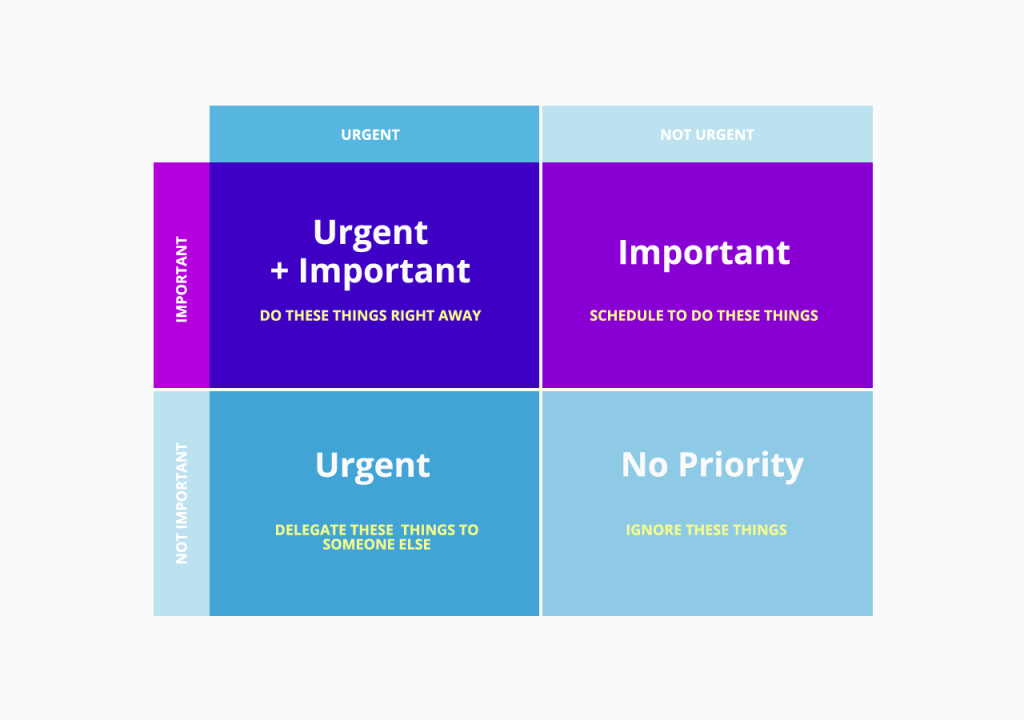
This is a tool I turn to every time I feel like my workload is overwhelming me. It’s designed to help you understand the status of each of your tasks so you can figure out which ones to get started on and which ones to ignore or put off.
If you’re a visual thinker, this is a useful exercise to do on a big sheet of paper or a whiteboard with coloured markers.
To use the matrix, draw out the four squares and label them as follows:
Top left: urgent and important
Top right: important but not urgent
Bottom left: urgent but not important
Bottom right: not urgent and not important
Then, either using your task list or just dumping out tasks as they come into your mind, write down everything you need to work on. As you add each task, think hard (be as honest as you can) about where they fit.
Because it is dependent on your objectives, your goals, and the kind of business you operate, what you consider urgent or important may not be the same thing that other people consider urgent or essential. It is therefore up to you to conduct an honest assessment of which of your responsibilities actually qualify as time-sensitive and significant, as opposed to those that only provide the impression of doing so.
Once I’m done adding all my tasks, I like to read through everything I’ve written down and re-evaluate each task. Sometimes a second pass will make me realize some of my tasks belong in different squares, so it’s worth checking each one.
When you’re finally done, you’ll be able to see what you should get done immediately (urgent tasks), what will help you move your business forward (important tasks), and what should be delegated, postponed, or cancelled (not urgent, not important).
How to get your focus back
It’s all well and good to plan ahead, but none of us can be focused on our work 100% of the time. So what can we do when our best planning efforts have let us down and we’re feeling overwhelmed and unfocused anyway?
Luckily, there are a few techniques proven to help in this situation.
Spend time in nature
Nature tends to recharge us, so we can focus better. If you’re lucky enough to have a park or forest nearby, try taking a walk there when you’re feeling overwhelmed.
The thought of walking itself can be beneficial for clearing your thoughts, but one study revealed that strolling in a park that is surrounded by nature does a better job of shutting off our brains so that they can recuperate.
City streets tend to be full of stimuli that require our attention so we can stay safe and not get in the way: horns blaring, traffic lights changing, people bustling around us, and traffic to look out for. Natural settings, on the other hand, tend to have a calming effect—perhaps due to the lack of threats to our safety in a quiet park.
Do something you enjoy
Whether it’s your internal chatter, stress, or something else, if you have a lot of noise in your mind, it can be impossible to focus on anything. Doing great work requires a quiet, focused mind.
For instance, if you already know how to play a musical instrument and do so for fun, this is a perfect refocusing activity. Playing an instrument requires your focus, but if you’re playing music you’re familiar with, you won’t work your brain the same way you do when working on or learning something new.
This immersion in something that takes your focus away without working your brain gives your mind a chance to recharge before you return to work.
Let’s Summarize!
Being an expert at managing one’s time calls for a blend of thoughtful preparation, methodical execution, and the capacity to be flexible. You will be able to regularly stay focused and make the most of your time if you cultivate a proactive mentality and include successful tools and strategies into your daily routine. This will allow you to accomplish both short-term activities and long-term goals. It is important to keep in mind that developing efficient methods of managing one’s time is a continual process that improves with experience and introspection.