
When it comes to maintaining boundaries with a friend, family member, business partner, or colleague, it can be challenging to even know how to establish boundaries in the first place.It is an act of selflove to refuse to accept certain behaviors, but it is also entirely feasible to communicate your demands with kindness and compassion. None of these approaches is better than the other.
Having boundaries requires you to be aware of what you require!
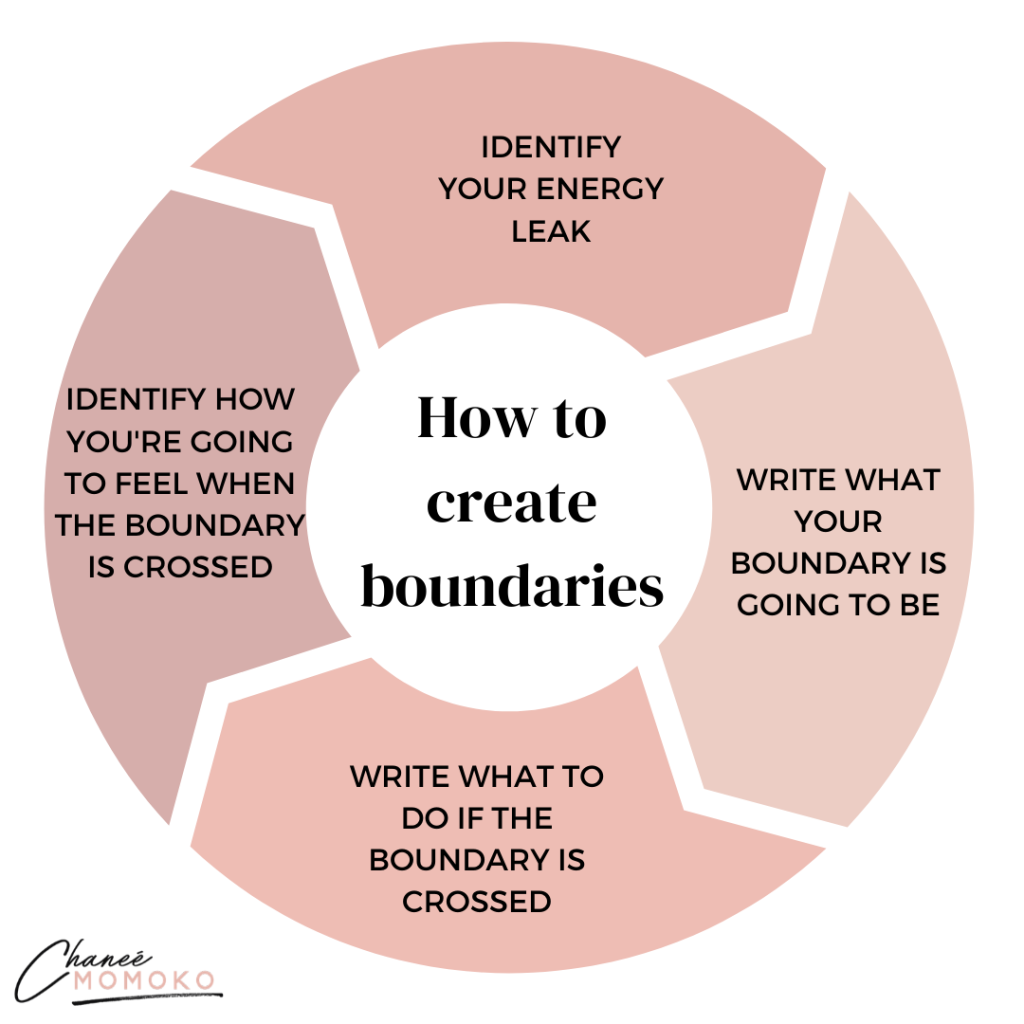
Getting in touch with oneself is typically the initial step in the process of establishing boundaries. The invitation to put a limit in place indicates that you know what you need and want, and the boundary ring provides the time and space for you to get that.
“The boundary ring fences the time and space for you to receive that.” But a significant number of women have developed the pattern of caring for others to the point where they have lost touch with their own desires and requirements.
Simply the thought of connecting with one’s own wishes can cause guilt feelings. The ladies I work with frequently have the mindset, “Who am I to have what I want?” or “It’s selfish to put yourself first.” I frequently hear these types of attitudes. Start to create the muscle of knowing oneself by engaging in daily practice.
Check in with how you are feeling and what it is that you require each morning. “The answer could be quite practical, for example: hiring an accountant to help with your taxes to lessen your concern and overload, or it could be a selfcare activity, for example, getting an early night or getting a massage to counteract weariness.” “If an early night is required, the boundary might be letting your family know that you would like their help with clearing up dinner so that you can take a bath and go to bed early.” “If an early night is required, the boundary might be letting your family know that you would like to go to bed earlier.”
Limits are meant to be loving, not punitive!

There is yet another way to look at the word “border,” and that is to regard it as a “fiercely loving” means to ring fence what it is that you require. For instance, a barrier could consist of cutting off time in your agenda every morning between 8:00 and 8:15 for stretching or between 12:00 and 1:00 for a stroll around lunchtime, so that meetings cannot be scheduled during that period of time. She has clients who schedule “meetings with myself” in their calendars to prevent interruptions from other people’s needs during their “me time.”
Limits can be established on a micro level!
If you’re new to the concept of setting boundaries on a micro level within a business, it can indeed be highly effective in maintaining a healthy work environment.
Individual Goal Setting: Work with each team member to establish clear and achievable goals. This helps create a sense of direction and purpose while also setting boundaries on what is expected of them.
Workload Management: Ensure that each team member’s workload is reasonable and manageable. Avoid overburdening individuals, as it can lead to burnout and decreased productivity.
Encourage Open Communication: Create a culture where employees feel comfortable expressing their needs and concerns. This includes encouraging them to communicate when they feel overwhelmed or need assistance. Allowing for appropriate adjustments to workload and responsibilities.
Flexible Scheduling: Consider offering flexible working hours or remote work options when feasible. This can help employees strike a better work-life balance and set boundaries between work and personal life.
Clear Reporting Lines: Clearly define reporting lines and decision-making authority within the organization. This prevents confusion and ensures that everyone knows whom to approach for specific matters.
Establish Time Management Techniques: Encourage the use of time management techniques to help employees stay focused and set boundaries around their work time.
Respect Personal Boundaries: Be mindful of personal boundaries and avoid intrusive inquiries into employees’ personal lives. Focus on creating a respectful and professional work environment.
Encourage Breaks and Rest: Encourage employees to take regular breaks and utilize their vacation time. Promote a healthy work-life balance, which ultimately improves productivity and well-being.
Offer Training and Development: Provide training and development opportunities for employees to enhance their skills and knowledge. This empowers them to excel within their designated roles and establishes a clear path for professional growth.
Remember that the success of micro-level boundary setting depends on continuous evaluation and feedback. Be open to adapting and refining the boundaries as needed to ensure they align with the evolving needs of the business and its employees, as well as their families and friends. “If there are times when people speak to you disrespectfully or situations where you’re always the one who picks up jobs that no one else wants to do, work through each scenario and ask yourself what boundary you could put in place to stop it from happening.
It’s possible that you’re the one who always takes care of organizing birthday gifts. Consider why this is the case, and consider if you could advise that individuals take turns doing this thing. You could believe that this is the least of your difficulties, but by standing up for yourself in this situation, you are getting the ball rolling for more significant issues. You will eventually be able to set clear boundaries, thanks to your efforts.
The ability to establish limits requires being able to say “no”!

The fact that establishing limits requires us to use the word “no” is the primary factor that causes many people to feel uneasy about doing so. If you want to live a balanced life, avoid feeling worried and overwhelmed, and keep yourself from being able to say, “I won’t do anything,” it is vital to be able to say, “I won’t do something.”
Think of a situation in which you might be able to say “no” more frequently. It could be something that happens frequently, like individuals constantly stopping you to ask questions. Yet, it could also be something entirely different.
Think of a sentence that you feel comfortable stating as a reply, such as ‘I have a lot on. I’d like to organize a catchup to work on these questions at another time.'” “I have a lot on; I’d want to schedule a catchup to work on these questions at another time.” Later, when you have the opportunity to catch up, you might clarify that you would appreciate it if they would hold their queries until the times that were already agreed upon. Can have a profound impact on both your professional and personal lives.
You’ll feel more clearheaded, like you have a better handle on things, and probably less stressed out or overwhelmed. But you will need to be aggressive and resolute, as well as willing to convey your boundaries to people in a clear and concise manner, which is something that they may require some adjustment time for.
‘You’ll also need to be fairly determined, as the role you’ve been playing as a helpful people-pleaser is how you’re likely to be known. ‘You’ll also need to be pretty determined to get what you want. Humans, in general, resist change; nevertheless, if you remain consistent in your efforts, they will quickly adjust to the new you.
Defining limits is not a simple task!
When you draw a line in the sand, you may worry that you will offend someone’s sentiments or even that you will be rejected, and with agood reason. But the reason you are experiencing these challenging emotions is just because you are trying something new.
After you’ve established some limits, things will gradually become less difficult to manage. Give some thought to the guidelines or restrictions that may be beneficial to you in your life. Try writing down your rules and even rehearsing telling them to people, or at least imagine yourself telling people your boundaries.
The purpose of boundaries is not to exclude people from a space!

Thinking of boundaries as “personal lines” that you draw around yourself can be a helpful mental image to have. But they are not intended to exclude individuals or prevent them from entering your elevator. Healthy boundary setting is more about paying attention to what you need rather than saying no to the demands of other people.
This is because healthy boundary setting is more about paying attention to what you need. Boundaries are in place for your protection and to make it possible for you to have a lifestyle that is both healthy and balanced.
Boundaries can take many forms: they can be physical (don’t stand so close to me), emotional (the right to not always share your feelings), sexual (I would do anything for love, but I won’t do that), intellectual (showing respect for different views), or financial (a couple having separate bank accounts).
Typical instances of setting boundaries include not responding to work emails outside of normal business hours, asking housemates not to enter your room when you are not present, and telling a partner not to raise their voice at you.
Individuals need to be reminded of where the lines are drawn!

The most important thing you can do to keep your boundaries intact is to make sure that other people are aware of them. If you have recently established some new limits, it will take some time and considerable repetition for those limits to become ingrained in the brains of others.
It is important to continue to stick to your own boundaries in order for other people to respect them. If you consistently enforce your own rules, then others are more likely to start respecting them. Be extremely explicit about exactly what it is that you mean when you talk about your boundaries. Instead of saying, I need more space, try saying, “I don’t usually like to hold hands when we are strolling down the street. This will get your point across much better.
It is inevitable that limits will, at some point or another, be subjected to scrutiny and possibly even violated due to the very nature of boundaries. When anything like this occurs, it is best to notify people in a nonconfrontational way exactly what your limits are and how they have crossed them. Tell them how this has affected you, and kindly remind them that you’d like them to respect your boundaries in the future, the instruction read.
In Conclusion!
Establishing clear boundaries is an essential component of a successful family and a prosperous business. Businesses have the ability to cultivate a positive and productive work environment through the establishment of clear and effective boundaries, which can ultimately lead to improved levels of employee satisfaction, increased levels of productivity, and better overall performance. The most effective approach to establishing boundaries is one that combines open and consistent communication with feelings of empathy for the other party. On a more microscale, boundaries include encouraging their employees to set individual goals, managing their workloads, encouraging open communication, providing flexible scheduling options, and respecting their personal boundaries. In addition, effective boundary setting necessitates the establishment of clear reporting lines, methods of time management, the encouragement of breaks and rest, the provision of opportunities for training and development, and the promotion of a healthy balance between work and personal responsibilities. Businesses are able to create an environment in the workplace that allows for the wellbeing of their employees and supports the accomplishment of organizational goals if they implement the aforementioned strategies and continually evaluate and adjust their boundaries as necessary. The existence of a thoroughly established boundary framework supports the success and ongoing viability of the business.